Focus On Animal Nutrition And Health
Focus On Animal Nutrition And Health

Allicin is a type of sulfur-containing organic compound extracted from garlic bulbs, mainly composed of diallyl trisulfide and diallyl disulfide. It has broad-spectrum antibacterial, immune regulatory, and growth promoting biological activities. With the continuous increase in aquaculture density, the contradiction between frequent diseases and antibiotic abuse has become increasingly prominent. Allicin has been widely used in the breeding of fish, shrimp, crab, ginseng and other species in recent years due to its low residue and resistance to antibiotics. This article reviews the role of allicin in promoting feeding and growth, enhancing disease resistance and immunity, regulating intestinal microbiota, and improving product quality, and discusses the dosage and safety issues in practical applications.
1、 Inducing food and promoting growth effect
Allicin has a strong volatile garlic aroma and has an olfactory stimulating effect on most aquatic animals, which can effectively improve feeding motivation. A certain amount of quantitative research data has been accumulated in promoting growth. Xiang Xiao and others added 25, 50, 75, and 100 mg/kg allicin to freshwater white carp feed, respectively. After a 40 day experiment, the weight gain rates of each experimental group were 57.49%, 91.25%, 101.26%, and 87.24% higher than those of the control group, respectively. The best effect was achieved with the addition of 75 mg/kg. In hybrid sturgeon farming, the experimental group supplemented with 50 mg/kg allicin showed an 11.51% increase in final weight, a 16.02% increase in weight gain rate, and a 5.84% decrease in feed coefficient compared to the control group. A study conducted by the Beidaihe Center Experimental Station of the Chinese Academy of Fishery Sciences in 2026 showed that adding 200 mg/kg allicin to the feed of Songjiang perch can significantly improve growth performance and reduce feed efficiency. It is worth noting that the promoting effect of allicin on growth performance is dose-dependent within a certain range, but the effect is not more significant with higher addition amounts. Some studies have observed a trend of decreasing growth promoting effect when added excessively.
2、 Antibacterial and immune enhancing effects
The antibacterial mechanism of allicin mainly relies on the thioether group in its molecular structure, which can react with thiol containing enzymes in bacteria and interfere with the primary metabolism of microorganisms. Common opportunistic pathogens in aquaculture, such as Pseudomonas aeruginosa, Pseudomonas fluorescens, and Vibrio species, are sensitive to it. At the production level, allicin has been used to assist in the prevention and treatment of fish enteritis, gill rot, vertical scale disease, and certain fungal infections.
In terms of immune regulation, existing studies have shown that allicin can enhance the non-specific immune function of aquatic animals. After adding allicin to carp feed, the levels of serum immunoglobulin G and immunoglobulin M increased, the secretion function of monocytes was enhanced, and the activity of T lymphocytes was also increased. At the antioxidant level, adding 300 mg/kg allicin to the feed of juvenile carp resulted in an increase in catalase, glutathione content, and total antioxidant capacity, while malondialdehyde content decreased. In addition, adding 100 mg/kg synthetic allicin to carp feed can increase the survival rate of aquaculture by 2.5 percentage points. Adding 200 mg/kg allicin to eel farming has shown certain effects in preventing red skin disease and enteritis.
3、 Regulating effect of gut microbiota
In recent years, with the maturity of microbiome technology, the impact of allicin on intestinal microbiota has been further understood. The results of metagenomic analysis showed that adding 200 mg/kg allicin to the feed significantly inhibited the abundance of potential pathogenic bacteria such as Pseudomonas and Vibrio in the intestinal tract of Songjiang perch, while promoting the proliferation of beneficial bacterial groups such as hydrogen phagocytes and reducing the abundance of multidrug resistance genes. This discovery suggests that the effect of allicin is not limited to direct antibacterial, but may also indirectly enhance host health by reshaping the gut microbiota ecology. In sea cucumber farming, the addition of 0.4% allicin to the feed also observed a synergistic effect on growth promotion, enhanced digestive enzyme activity, and optimized gut microbiota structure.
4、 Product quality and improvement of breeding environment
The sulfur-containing ether compounds in allicin can participate in the regulation of lipid metabolism in animals, and some flavor substances are deposited in muscle tissue, giving the product a unique aroma. At the same time, it can reduce the earthy smell of farmed fish to a certain extent. In terms of environmental improvement, some metabolites of allicin have the effect of repelling mosquitoes and flies after excretion, which helps to reduce the risk of insect breeding and vector transmission in farms. In addition, adding allicin to feed also has a certain anti mold effect, which is beneficial for extending the storage period of feed.
5、 Appropriate addition of dosage and safety boundary
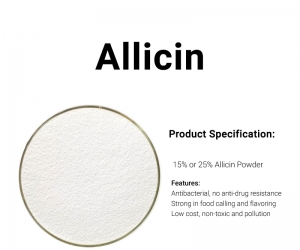
At present, commercially available allicin products mostly exist in powder form with a content of 15% or 25%. In the conventional formula, adding 100 grams of allicin with a 25% content per ton of feed is a commonly used starting amount, which can be increased to 150 grams to enhance the feeding effect; When the feed contains a high proportion of odorous ingredients such as rapeseed cake and meat and bone meal, it can be considered to add up to 200 grams.
However, there are significant differences in the tolerance of different aquaculture varieties to allicin, and the appropriate dosage should be determined based on the specific target population. Based on existing research, the recommended dosage for Songjiang perch is 200 mg/kg, for hybrid sturgeon it is 50 mg/kg, for eels it is 50 to 100 mg/kg, for river carp it is 300 mg/kg, for sea cucumber it is 0.4%, and adding an appropriate amount of allicin during the tilapia fry stage can also help improve survival rate and pond size.
It should be noted that the effect and dosage of allicin exhibit a typical inverted U-shaped relationship, with moderate promotion, excessive inhibition, and even toxicity. When 0.6% allicin is added to sea cucumber feed, the diversity of gut microbiota decreases to the lowest level, the abundance of Proteobacteria significantly increases, and Vibrio becomes one of the dominant bacteria. All eels died within a short period of time at a concentration of 800 mg/kg. When the concentration of allicin in the feed of Macrobrachium rosenbergii increased from 10 g/kg to 20 g/kg, the expression levels of related immune genes began to decrease. The above results clearly indicate that the use of allicin in production must strike a balance between effective dosage and safety boundary. Randomly increasing the addition amount is not only useless, but may also bring breeding risks.
Conclusion
Allicin has multiple functions in aquaculture, including inducing food and promoting growth, enhancing immunity, optimizing gut microbiota, and improving product flavor. It does not have the problem of traditional antibiotic residue, which is in line with the current development direction of green aquaculture. However, due to its narrow effect range and significant species differences, it is necessary to scientifically set the addition amount based on the breeding variety, growth stage, and feed formula in practical applications to avoid blind overuse. Future research should further clarify the optimal addition threshold of allicin under different breeding conditions and its compatibility effects with other additives, providing a more comprehensive theoretical basis for its precise application.
Focus on feed additives global
supply for 13 years
Hebei Shuntian biotechnology Co.,Ltd.
Add:Machang Town,Qing County ,Cangzhou City ,Hebei,China
Tel: +86-317-2135910
E-mail:Erica@stbiol.com
© Copyright - 2018-2020 : All Rights Reserved.